Newsletter: September 2009, part 2
Sep. 3rd, 2009 10:13 pm![[identity profile]](https://www.dreamwidth.org/img/silk/identity/openid.png) rhapsody11.livejournal.com posting in
rhapsody11.livejournal.com posting in ![[community profile]](https://www.dreamwidth.org/img/silk/identity/community.png) silwritersguild
silwritersguildNewsletter: September 2009
The newsletter this month will be posted in two posts as we have exceeded LJ's posting limits. Find the first half here.
Table of Contents
- Linguistic Foolery:: Sindarin vs Quenya: RELEVANCE FIGHT!, by Darth Fingon. Should you use Sindarin or Quenya for the Elvish in your stories? This month's Linguistic Foolery begins to answer that question.
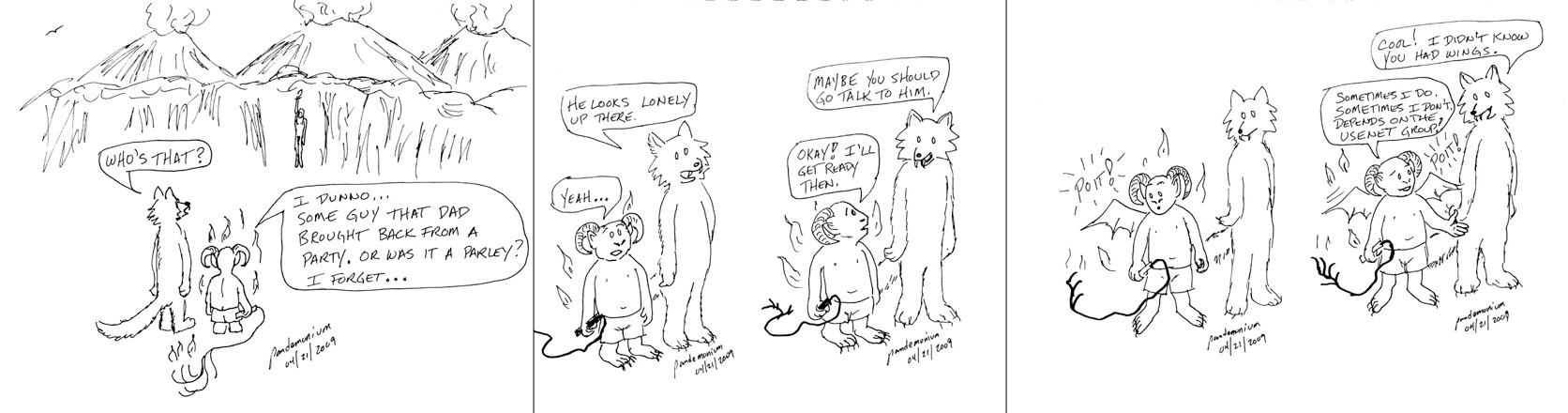
- Funny Pages: Gothmog and Draugluin, by Pandemonium_213. New this month, we introduce a section of funnies! Gothmog and Draugluin discover what Melkor has brought home.
- Funny Pages: Chibi of the Month, by Whitewave. Finrod Felagund, beloved of men (and women), on Amarië, getting lost in Minas Tirith, and how he earned the nickname "the wise."
- Current Challenges. This month, we introduce a new challenge, revisit a past challenge, and offer a new quote for the month.
- Around the World and Web. Announcements and events from Tolkien groups beyond the SWG.
(Please note that the Table of Contents links only work "inside the LJ cut.")
Linguistic Foolery
Sindarin vs Quenya: RELEVANCE FIGHT!
Darth Fingon
Where Tolkien's two major Elvish languages are concerned, there's a lot of confusion regarding which one is used when for naming original characters and including random words and snippets of dialogue. This is a Back to Basics Linguistic Foolery article for people who have no interest in listening to me blathering about obscure stuff like how the letter D in primitive Elvish roots might present itself in later Vanyarin dialects. Instead of that, let's pit Sindarin against Quenya in an ultimate battle showdown to see which is more useful in the average fanfiction story. And let's begin with a very quick reference guide:
If you write Second or Third Age Elf fiction, always choose Sindarin.
If you write pre-Second Age Elf fiction, it's probably better to choose Sindarin.
Okay, that's a little absolute. Let's examine these scenarios in greater detail, starting with a brief overview of the two languages.
Quenya is the language spoken by the Noldor and Vanyar in Aman. While the Noldor did bring their language back to Middle-earth with them at the start of the First Age, it was not adopted by the locals. Instead, the Noldor preferred to learn Sindarin. When Thingol learned of the kinslaying at Alqualondë, he passed a ban on Quenya, but only in his own realm. Quenya became forbidden in Doriath; not so elsewhere. Thingol's ban would not have affected the language the Noldor used among themselves in their own homes. We have examples of Quenya being used in Gondolin in the later First Age: Aredhel gave Maeglin the Quenya name Lómion, and Eärendil is likewise a Quenya name. After the First Age, though, it does not appear that Quenya was used as anything other than a ceremonial or poetic language anywhere in Middle-earth. Sindarin took over as the language of daily use.
Sindarin, through various evolutions and dialects, has been the primary Elvish language of Middle-earth since before the First Age. It is the language Tolkien used almost exclusively for naming characters and places in Middle-earth. The vast majority of the names given in The Silmarillion are Sindarin names, which makes Sindarin the better choice in most cases even when writing Silmarillion fiction. If in doubt about which language to use, choose Sindarin. It has a much higher probability of being appropriate.
Even if you know very little to nothing about Elvish languages, it's not difficult to differentiate between the two at sight by looking for a few important clues. Quenya words and names are far more likely to end in a vowel: compare Q Findekáno, Ondolindë, Endórë to S Fingon, Gondolin, Endor. A Sindarin word will never end in ë. If the letters B, D or G occur in (Noldorin) Quenya, they will always be part of a cluster (MB, RD, NG, etc.) and never at the beginning or ending of a word, but they can stand anywhere on their own in Sindarin. Quenya uses K, Q, and X; Sindarin does not. Sindarin uses CH, DH, LH, RH, and TH; (Noldorin) Quenya uses none of these. Sindarin uses both acute and circumflex accents, while Quenya uses only acute. However, acute accents will show up far more frequently in Quenya than in Sindarin.
Typically Quenya words: Helkaraxë, Valinórë, Turukáno, Quendi, Nyellë
Typically Sindarin words: Elrond, Gurthang, Edhel, Rhîw, Acharn
So assuming that Sindarin is the default to be used in all other cases, when and where would Quenya names, words, or dialogue be appropriate? Primarily, characters would be speaking Quenya in Valinor during the First Age and prior. An Elf born in Valinor would be named in Quenya, and likewise so would places in Valinor. Sindarin would be unknown here until the end of the First Age and the migration of Elves from Middle-earth.
Throughout the First Age, as Noldorin society became more and more integrated with that of the Sindar of Beleriand, and as those Elves that had been born in Valinor were killed, the use of Quenya as an everyday spoken language waned. By the Second Age, its function had shifted to that of a language of ceremony, lore, and poetry for those of Noldorin or Númenórean descent; proclamations were still spoken in Quenya (as evidenced in numerous places in LotR) even if it no longer held any relevance in day-to-day life. After the First Age, Quenya dialogue would be appropriate in a ceremonial context concerning Noldorin and Númenórean characters.
The continuation of Quenya naming, for people and places alike, is more limited. From the Second Age on, Elves of Middle-earth no longer use Quenya names for themselves or their lands. Where Quenya names were used, though, was in Númenor. While the language was not spoken there on a daily basis, the Númenórean royals used Quenya, rather than Sindarin, names, until the breaking of ties with the Elves. Thereafter, only the Faithful continued the Quenya naming tradition, and through them, Quenya names survived well into Third Age Gondor. The names of all of Arnor's and Gondor's kings (and the first few of Gondor's stewards) are Quenya, including Aragorn's chosen name, Elessar Telcontar, and that of his son, Eldarion.
With all of that in mind, when would Quenya be used to name a city or an original character in your story? If the city is in Valinor or Númenor, it would be named in Quenya. The character would be named in Quenya if he or she was born in Valinor to Vanyarin or Noldorin parents, or is a queen, prince, or princess of Númenórean descent. Other inhabitants of Númenor might be named in Quenya, though Sindarin (and, of course, Adûnaic) names also appear. The probability of a Quenya name here would have varied across time period, geographical location, and social status. Gondolin is another place where children could have been named in Quenya, though, given that its population comprised both Noldorin and Sindarin Elves, Sindarin names would have been found here as well. Quenya may have been used in other Noldorin realms, but there is unfortunately little data to support a claim either way. Of the few known first-generation Noldorin descendants to be born in Middle-earth in the First Age, Eärendil was named in Quenya, Maeglin in both languages (and Gil-galad, too, if you consider all possible names), and Finduilas in Sindarin.
All other Elves of Beleriand, and the Edain, too, would have Sindarin names, and their lands, rivers, and strongholds are named in Sindarin. Less is known specifically about Elves in the Second Age, but their cities (Mithlond, Ost-in-Edhil) have Sindarin names. Sindarin would be the language to use when naming any Elf of Middle-earth in the Second Age and beyond.
The TL;DR version of all that waffle? Quenya is limited in its usefulness to a few specific situations. Looking through all of Tolkien's writing, the vast majority of names that appear are Sindarin. Even in the First Age. Even in Valinor, where Sindarin did not exist. But we can write this off on the assumption that The Silmarillion, as a history, was 'written' by a Sindarin speaker who rendered all the names into the common language of the day. This is why, if you're not sure which language is the one to use and you want to be safe, you should choose Sindarin. Tolkien did.
NEXT MONTH: Sindarin is a Quenya Word, and other ways to make fanfiction Elvish way more confusing.
Have a question or item you'd like to see discussed in a future instalment of Linguistic Foolery? Send an email to loremaster@silmarillionwritersguild.org and share your ideas.
View past Linguistic Foolery columns.
(Return to Top)
Funnies
Gothmog and Draugluin
Pandemonium_213
Hi! My name is Gothmog. My middle name is Kosomot. My mom's name is Ulbandi Fluithuin. My dad is Melkor Black Foe of the World. I live in a big place called Thangorodrim. My best friend is a wolf named Draugluin. He's a lot of fun! You'll also meet my babysitter ("I'm not a babysitter. I'm an observer.") Professor Thû; he really likes rings and has the best game room ever in Tol-in-Gaurhoth.
You may remember Draugluin and me from some books written by J.R.R. Tolkien:
"...Gothmog, Lord of Balrogs, high-captain of Angband, was come."
"Then Sauron sent Draugluin, a dread beast, old in evil lord and sire of the werewolves of Angband."
Professor Tolkien wrote me as being very, very bad. But I didn't start out that way! Well, maybe a little.
Draugluin and I are not just about smiting and devouring. We have fun, too. We might remind you a little of a comic strip in your primary world: Calvin and Hobbes by the "magnificent Bill Watterson" as the human (pandemonium_213) who draws us (badly) calls him.
I will also share this space with “Stinky Pete” Mêshûgganâscar, Maia of Mandos, and his pals. I think Mandos is cool because he's really scary and has a snake's tail.
I like macaroni and cheese, PS2 and Wii. I really hate big fountains and pointy helmets.
Anyway, I think this is where pandemonium_213 is supposed to make a disclaimer that Mom, Dad, me, Draugluin, Professor Thû, all the Elf dudes and Men, Stinky Pete and his Maiarin pals, their Valarin bosses and whoever else shows up are the property of the Tolkien estate, and I am just here for fun and games but no profit. You know what? I'm a parody! I think that means I'm barely legal.

Click to view full-sized.
Chibi of the Month
Whitewave


(Return to Top)
Current Challenge
Another Place in Time
When we write about Silmarillion events, our stories often concern the time and place where the action primarily occurred. However, there is a broad world beyond--what was going on there, at the same moment in time?
This challenge asks authors to move beyond the places and times of familiar events to consider what was going on elsewhere in Arda at the same time as a major event covered in The Silmarillion. How--if at all--did the event impact what was transpiring elsewhere at the same time?
Here are some ideas to get you started:
- We just finished Akallabêth in August last month, and most of the stories concern what was going on upon the isle of Númenor during the Second Age. But what about Middle-earth? Valinor? As Númenor tottered towards its fall, what was life like elsewhere in the world, and did these people have any notion that a major civilization was about to be wiped off of Arda?
- During the Darkening of Valinor and Melkor's escape back to Middle-earth, the Sindarin and Avarin Elves remained in darkness, as they had for centuries. But were they wholly oblivious of the destruction wrought an ocean away and of the changes about to come upon their own lands?
- It is said that the Valar shut their eyes and ears to the exiled Noldor in Middle-earth, but we have proof--the answers to Fingon's prayer to Manwë and Ulmo's numerous manifestations in Beleriand--that this was not always the case. What was life like in Aman after the Noldor left? What awareness--if any--did the Valar and the Elves that remained behind have of their loved ones in the Outer Lands?
Challenges Revisited: Olórë Mallë
One of J.R.R. Tolkien's early concepts allowed for a "dream bridge" between our world and Middle-earth called Olórë Mallë. Aside from its appeal as a means to visited a beloved alternate universe, Olórë Mallë represented a concept that--even after the idea of the dream path itself had been abandoned--remained important in Tolkien's writings: that deeper truths could be reached through myth, imagination, and dreams.
"It has been said to me, though the truth I know not, that that lane ran by devious routes to the homes of Men, but that way we never trod when we fared thither ourselves. It was a lane of deep banks and great overhanging hedges, beyond which stood many tall trees wherein a perpetual whisper seemed to live; but not seldom great glow-worms crept about its grassy borders ... These too were the earliest children -- the children of the fathers of the fathers of Men that came there; and for pity the Eldar sought to guide all who came down that lane into the cottage and the garden, lest they strayed into Kôr and became enamoured of the glory of Valinor; for then would they either stay there for ever, and great grief fall on their parents, or would they wander back and long for ever vainly, and become strange and wild among the children of Men."
Early in Tolkien's mythology, in The Cottage of Lost Play from The Book of Lost Tales 1, he tells of an extraordinary road that leads from the homes of Men to Tol Eresseä. Along this road, the children of Men travel in their dreams and visit the Elves and a wondrous world beyond their own borders. While the idea of Olórë Mallë--or the Path of Dreams--was quickly abandoned, dreams remained important throughout Tolkien's works. Through dreams, Melian receives word of what transpires in Valinor. Finrod and Turgon are moved to establish their respective hidden kingdoms because of Ulmo's voice in their dreams. Thingol receives hints of Beren's arrival and Beren receives portents of his father's death in the strange world of dreams. Eärendil turns his ship back to Beleriand because of a dark dream.
This challenge asks authors to consider their characters' dreams. What dreams haunted the Noldor, Edain, and Dwarves on the night before the Nirnaeth Arnoediad? What dreams of her child might have caused a mother to name him as she did? What silly, hopeful dreams drove a character in his youth? Any story, poem, or drabble about dreams will do. This month, we invite our members and guests to step upon Olórë Mallë and consider where it leads.
Quote of the Month
"In bed my real love has always been the sleep that rescued me by allowing me to dream."- Luigi Pirandello
Want more challenges? Check out our complete challenge listing for more than three years' worth of challenges to inspire your writing!
Have an idea for a challenge? Some of our most popular challenges have been created by you, the members of SWG! If you have a plotbunny gnawing at your ankle, a favorite quote, or a favorite character that you think might inspire others as well, please send an email to moderator@silmarillionwritersguild.org and we'll try to include your challenge in our next newsletter!
(Return to Top)
Around the World and Web
LotR Genfic Community: September 22
The September Challenge will have the theme of "September 22". It does not have to be the most obvious September 22, nor does it have to be set in the Shire, but can be any September 22 at any place or any year or age of Middle-earth. Your element will be a story-starter sentence. The "starter" is to "get you started", and does not have to be the first sentence, but may appear anywhere in the story.
Stories will be due the weekend of Friday, September 18, and will be revealed on Monday, September 21. To request your elements, please leave a comment to this post.
Teitho
At Teitho, the challenge for September is Crossroads: There are different angles from which you can tackle this theme. You could interpret it in a realistic manner and write about characters travelling or standing at a crossroads. If you prefer, you can of course also use the metaphorical meaning of Crossroads and write about turning points in a someone's life - and there are as many as there are characters in Tolkien's world! The deadline for this challenge is September 25th. If you want to know more and/or participate, please visit the website.
A Long-Expected Contest (ALEC)
What if Beleg had lived or Fingolfin or Fingon?
Or Maedhros had died in captivity instead of being saved by Fingon?
Celebrimbor's death, one of the most tragic ones IMO, *could* be changed and he could live.
Would he make more rings for the Elves?
The theme for September is 'What If So-And-So Lived/Died'.
It does have to be based on documented events and it will need to be based on an actual canon character in the books. Each writer has until September 30th to turn in the story to alec_votecoordinator@yahoo.com.
Please include the proper formatting for LJ. If you have any questions about how to do that, feel free to ask.
ALEC locations -
http://groups.yahoo.com/group/A_Long_Expected_Contest/
http://community.livejournal.com/a_l_e_c/
First Age RPG
We need players for Quenta Eldarion, a First Age RPG based on the AU setting where Fëanor lives and remains King of the Noldo. Great characters still remain open! Contact Alassante at Alassante7@yahoo.com for more information.
Middle-earth Fanfiction Awards
The first of the reviews written for the 2009 Middle-earth Fanfiction Awards (MEFAs) were displayed at our website beginning September 1. To read reviews for your story:
- Log in to www.mefawards.net/MEFA2009/
- Click the link "Review Reviews Left By Others For Your Stories."
It's not too late to start reviewing yourself. Nominated authors can vote for any stories in this year's competition (except their own, obviously). Anyone else can participate by joining the MEFAwards Yahoo group. If you have forgotten your password or need other help joining up, please check out this FAQ:
www.mefawards.net/MEFA2009/index.php?page=FAQtechsupport#ts_0
and if you still are having trouble, you may email me at mefasupport-at-mefawards-dot-net for additional help.
Enjoy the reviews!
Geocities Free Web-Hosting Is Closing on 26 October 2009
Geocities has long provided free webhosting and has been a popular choice for fandom websites. Geocities has announced that it will be closing its doors on 26 October 2009. That means that any content left on Geocities after that date will be lost.
If you host (or know someone who hosts) with Geocites, it is recommended that you save copies of your site and move your content to a new host. If you frequent a site that is hosted through Geocities, and the owner does not plan to move the content (or perhaps has deserted the site altogether), it is recommended that you take screencaps of any content you wish to access after 26 October.
The Organization for Transformative Works (OTW) has announced its Geocites Rescue Project to provide support and resources for fannish sites currently hosted with Geocities. Information is available for relocating both fiction archives and fandom resource pages.
If you host a Tolkien fandom-related page through Geocities and need a temporary home for your content while you seek out other hosting options, please contact me at DawnFelagund@gmail.com, and I might be able to help you find a place to temporarily host your site.
Around the World and Web is provided for our members to inform them of events in the larger Tolkien community. SWG is not affiliated with and does not endorse the groups that we feature in Around the World and Web, and we are not responsible for content on sites outside of our own. Please use discretion and caution when visiting unfamiliar sites on the Internet.
Would you like to see your group or event featured on Around the World and Web? See our Promotions Page for more details or email us at moderator@silmarillionwritersguild.org.
(Return to Top)


![[personal profile]](https://www.dreamwidth.org/img/silk/identity/user.png)